
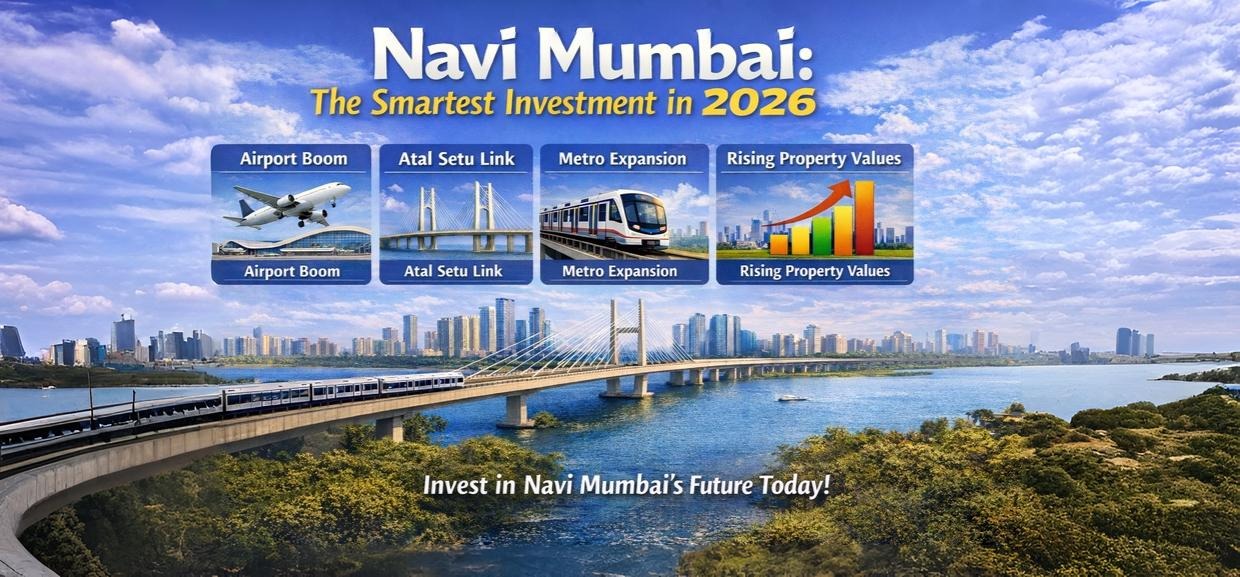
For decades, homebuyers and investors compared Navi Mumbai to its older sibling across the harbor and called it the “affordable alternative.” That description no longer tells the whole story. In 2026, Navi Mumbai has evolved into a self-sustaining, infrastructure-rich, and rapidly appreciating real estate destination - one that stands confidently on its own merits.
Whether you are a first-time homebuyer, a seasoned investor, or an NRI looking to plant roots in India, here is why Navi Mumbai deserves serious attention this year.
The numbers speak for themselves. Average apartment prices across Navi Mumbai rose from approximately ₹14,800 per sq. ft. in 2021 to ₹18,100 per sq. ft. in 2025 - a cumulative appreciation of over 22% in five years. This is not a speculative bubble; it is fundamentals-driven growth backed by jobs, infrastructure, and genuine housing demand.
Specific micro-markets have outperformed even that impressive average:
“Navi Mumbai has entered a phase where price growth is being driven by fundamentals rather than sentiment.” - Vishal Raheja, Founder & MD, InvestoXpert Advisors"
The Navi Mumbai International Airport (NMIA) is arguably the single biggest catalyst for long-term value in the region. Locations like Ulwe, Panvel, Dronagiri, and Pushpak Nagar - all within striking distance of the airport - are attracting early-stage investors thinking 5 to 10 years ahead.
Airports create aerocity ecosystems: hotels, logistics hubs, commercial offices, and premium residential clusters. Investors who entered airport-adjacent markets before full operationalization in cities like Bengaluru and Hyderabad saw exceptional returns. Navi Mumbai is at that precise inflection point today.
The Mumbai Trans Harbour Link - now the world’s longest sea bridge - has done something transformative: it has shrunk the psychological distance between South Mumbai and Navi Mumbai. Senior professionals working in Nariman Point or BKC can now seriously consider a home in Kharghar or Panvel.
This connectivity upgrade has fuelled a 20% price surge in areas like Ulwe and Panvel, and is expected to continue drawing affluent end-users who previously dismissed Navi Mumbai due to commute concerns.
Navi Mumbai is building out its metro network at speed. Phase 2 and Phase 3 of Metro Line 1 span 11 km, linking Belapur, Kharghar, Taloja, and Pendhar. Combined with the harbour-line rail network serving Vashi, Sanpada, Nerul, and Belapur, Navi Mumbai’s internal connectivity is becoming one of its strongest selling points.
Properties close to metro corridors have historically commanded both premium pricing and stronger rental demand - a double advantage for investors.
Navi Mumbai is not just a buy-and-hold story. Rental demand is robust and growing, driven by professionals at Belapur CBD, Ghansoli, Koperkhairane, and Taloja industrial zones. Some of the strongest rental yield areas include:
| Location | Rental Yield |
|---|---|
| Sector 23, Ghansoli | 7.1% |
| Sector 4, Nerul | 6.9% |
| Sector 44, Seawoods | 6.4% |
| Sector 13, Sanpada | 6.2% |
For investors, this means rental income today and capital appreciation over time - a balanced and attractive proposition in a market where most tier-1 cities offer one or the other, rarely both.
Navi Mumbai is not a work-in-progress city waiting to grow up. It already has:
This ready-made quality of life is a major pull for families who want a balanced urban lifestyle without the chaos of central Mumbai.
Beyond residential, Navi Mumbai’s commercial story is getting bigger. Reliance Industries has secured a lease of 4,000 acres in the Navi Mumbai SEZ to develop a global economic hub. Additionally, India’s first data park centre - spanning 600 acres adjacent to the Taloja Industrial Estate - is set to bring significant employment and infrastructure investment to the region.
Where jobs go, housing demand follows. These large-scale commercial developments are pre-loading demand for residential real estate in nearby nodes for years to come.
Even after years of appreciation, Navi Mumbai offers compelling value compared to South Mumbai or the western suburbs. Affordable areas like Taloja Phase 1 and 2 are still available at ₹8,700–₹9,000 per sq. ft., while mid-segment properties range from ₹12,500 to ₹19,000 per sq. ft.
For buyers who want a well-planned city with modern amenities - and don’t want to pay a premium for a Mumbai postcode - Navi Mumbai delivers exceptional value for money.
Regulatory clarity under MahaRERA has transformed buyer confidence in Maharashtra’s real estate market. Developers must register projects, disclose timelines, and be held accountable for delivery. For homebuyers who remember the anxiety of pre-RERA investing, this framework is a game-changer.
At Moraj Group, all our projects are RERA-compliant. Our decades-long track record of on-time delivery - acknowledged consistently by our homeowners - reflects a commitment that predates regulation and runs deeper than compliance.
Since 1985, Moraj Group has been building more than homes in Navi Mumbai - we have been building communities. With 30+ projects delivered, lakhs of square feet handed over, and thousands of families settled, our legacy is written in the city’s skyline.
Under the leadership of Chairman Mohan Gurnani and Director Priyaa Gurnani - who brings over 35 years of interior design expertise - every Moraj project is conceived with the homeowner at the centre. We design, we build, and we deliver. Nothing is outsourced; nothing is left to chance.
Our ongoing projects - Moraj Opulence , Moraj Waterfall Gateway, and Jewel Crest - are designed for the discerning buyer who wants the best of Navi Mumbai’s growth story without compromise.
2026 is not the year to wait and watch. It is the year to act - while Navi Mumbai’s best opportunities are still within reach.